Tuesday, 25 May 2010

Tax shenanigans

Today I've been twisting and turning like a twisty-turny thing to avoid paying capital gains tax when I move to Norway.  Overall I've basically sold SLXX and raised my stake in Tesco, British American Tobacco and Diageo.  In the process I've crystallised all my capital gains in all 4 stocks (by moving things in and out of ISAs).

Tesco, British American Tobacco and Diageo are now each 6.4% of my portfolio, up from 4.1%, 4.5% and 5.5% respectively.  SLXX was 5.1% of my portfolio.  There has been no overall change in my portfolio size.

I still have 3 capital gains that I need to crystallize:
  • Berkshire Hathaway
  • iShares Emerging Markets
  • iShares Asia/Pacific Dividend
My gains in NWBD and LLPC are significant, but the bid/ask spread in these shares is large enough that it is not worth selling and rebuying them.

Tuesday, 18 May 2010

Trusts and funds

A slight departure from my usual material in this post - I'm going to look at some of the ways for a novice to invest in the stockmarket without going to the trouble of actually researching and buying individual shares.

Unit trusts vs Investment trusts vs ETFs
A unit trust is a vehicle that pools investors' money and uses it to invest in shares, bonds or other instruments.  When an investor buys units in the trust, these are created fresh and the fund manager uses the investor's cash to buy new investments.  When an investor cashes in their units, the fund manager must sell investments to realise the money required or (more usually) keep a small amount of cash on hand to deal with redemption requests.

In contrast an investment trust is a company that owns a pool of investments.  An investor buys shares in the investment trust at the market rate, and must buy them from another shareholder who is selling.  The shares are bought via a stockbroker in the same way as any other shares.  No new money is given to the fund manager, and the fund manager never has to sell investments to deal with redemption requests.  The share price of the investment trust will bear some relation to the value of its portfolio, but will not usually track it very closely.  The share price of the trust can diverge by more than 20% from its underlying net asset value, depending on supply and demand of its shares.

An Exchange Traded Fund (ETF) is like an investment trust, but one in which new shares can be created, or old ones destroyed.  This mechanism serves to keep the ETF share price very close to its underlying net asset value.

Active vs Passive management
ETFs are nearly always passively managed, i.e. they don't attempt to beat the market, simply to track a particular index (such as the FTSE 100).  Unit trusts and investment trusts are most often actively managed, i.e. they are run by a fund manager who buys and sells in order to try and outperform.

Superficially you might think that actively managed funds were a good thing - after all it's better to beat the index than just to match it.  The trouble is that the average fund manager will be exactly that - average.  There's no telling which manager will manage to beat the market, and which will underperform.  And this is where the really important part comes in - fees.  An average fund manager will give an average market return minus fees.

Fees
Unit trusts will usually charge a fee upfront when you initially invest (although you should be able to avoid this by buying via a fund supermarket), and then an annual management charge.  Investment trusts and ETFs will have no up-front fee, but you will have to pay stockbroker charges (say £15 or so) and (if the investment trust or ETF is UK-listed) stamp duty of 0.5% - and then an ongoing management charge is deducted from the investment trust's assets.

Actively managed funds will typicall charge a lot more than passively managed funds.  Here are some examples:
  • Invesco Perpetual Income is an actively managed unit trust.  It has an initial charge of 5% (although you should be able to avoid that if you buy via a fund supermarket rather than a normal financial adviser) and an annual management charge of 1.5% plus 0.19% other expenses
  • Legal And General UK Index is a passive unit trust.  It has no initial charge and an annual management charge of 0.4% plus 0.15% other expenses.
  • Foreign and Colonial is an actively manageed investment trust.  It is UK-listed so you will pay 0.5% stamp duty up-front, plus stockbroker fees.  It has a total expense ratio of 0.58%.
  • iShares FTSE 100 is a passive ETF.  It has a total expense ratio of 0.4%.  It is listed in Ireland, so there is no stamp duty to pay.
So what is the best type of fund?
I don't believe it's possible to pick a winning fund manager in advance, and therefore I am totally ambivalent about whether a fund is actively or passively managed.  What I can predict in advance is the fees that will be charged - and a fund that charges the lowest fees should, on average, give the best return over the long term.

Personally, therefore, I would opt for the cheapest type of fund, which usually means one that is passively managed and tracks a popular index such as the FTSE 100 or FTSE All Share.  The Legal and General fund is pretty good at 0.55% per year, but the iShares ETF is even better at 0.4% (plus £15 or so up front in stockbroker fees).

But which fund should I invest in?
I'm not here to tell you which fund you should invest in - except that you should keep the fees as low as possible.  I think for a UK-based investor a FTSE 100 or FTSE All Share tracker is perfectly adequate.  The FTSE 100 will tend to be more internationally diversified, whereas the All Share will cover a more diverse set of sectors.

Resources
trustnet has details on a huge number of unit trusts, investments trusts and ETFs.

If you want to invest in an actively managed unit trust then your best bet is probably going through a fund supermarket such as sfs (there are many others - google "fund supermarket").

If you want to invest in the Legal and General unit trust then you can do so directly through their website.

There are many online stockbrokers who will let you invest in ETFs, investment trusts and ordinary shares.  I use Motley Fool.

Vero - mission accomplished

My usual investing style is buy-and-hold, but last week I made a purchase for the very short term - Vero Software.  As I wrote here, Vero seemed on the verge of being acquired at what I thought almost certain to be a price higher than they were currently trading at.

Yesterday the announcement was made - and although it was marginally below the lower end of my expectations, it still gives me a 17% profit for what will be a holding period of ~2 months.  Enough shareholders have already committed themselves to voting in favour that the deal looks done and dusted.

I was expecting the offer to come in at about 18-24p, but in the end the offer was made at 17.5p, 40% above their recent average of 12.5p.  So I was slightly on the optimistic side, but left myself plenty of margin of safety by buying at 15p.

The purchase should be complete in mid-July, at which point I can collect my 17.5p per share.

I don't expect to do much trading of this sort, but when the opportunity presents itself I'm certainly not going to spurn it.

Monday, 10 May 2010

Goodbye Next, Hello Vero

Vero Software is a tiny IT company that provides software for the mould and die sector. They are on my radar because I'm a member of an investment club that has held their shares for the last year or so.

Their preliminary results came out today (http://investegate.co.uk/Article.aspx?id=201005101452136441L). The news was unspectacular - their revenue was down a bit, EBITDA up a bit, EPS down a bit. What caught my eye was this paragraph:

On 16th September 2009, the Company announced that it was in talks which may or may not lead to an offer for the Company. Discussions with more than one party subsequently followed and the Company is pleased to report that negotiations are now at an advanced stage and it expects to be able to make an announcement within the next two weeks. There can however be no certainty that an offer will be made nor as to the terms on which any offer might be made.

Now I was aware that Vero had been in talks about a potential offer, but at no point had they given a hint that negotiations were at an "advanced stage". So this came as a pleasant surprise.

Vero have been wibbling around at 12-13p per share for ages. Since talks about an offer have reached an advanced stage, I can only assume that someone is willing to offer a reasonable premium above the market price - lets say 18-24p. And if an announcement is due in under 2 weeks, the share price could move very quickly.

On that basis, I quite fancied a punt at ~15p, for a very quick 20-60% profit. Consistent with my aim for this year of realising most of my accumulated capital gains, I sold all of my Next shares (for a profit of 99%, including dividends) to free up some cash, and put up a little more than half the proceeds towards a buy order for Vero at 15p.

A bit under half my order was fulfilled before the end of the day's trading, and the rest remains outstanding as a limit order.

The shares I have manged to pick up now form 1.7% of my portfolio, and if the limit order is completed that will rise to 3.7%.

In 2 weeks time I might be looking rather foolish, but I think the shares look pretty cheap even ignoring the offer, so my downside should be limited. If it looks like I'm going to be lumbered with them for the long term then I'll make a more detailed post with my rationale for holding - at the moment this is purely a short-term play on this potential offer.

Wednesday, 21 April 2010

Game Group

It's been a while since I bought a new share, but I'm seriously considering dipping my toe in the water for the sake of Game Group. They announced their preliminary results today, with the following highlights:
  • Operating profit down 28%.
  • Revenue down 10%.
  • Their CEO and UK Chief Operating Officer are both stepping down.
  • For the first 11 weeks of the year like-for-like sales are down 14%.

How could I resist?

Background

Game Group are the market leading game store in the UK with 600-700 stores. They have another 700 abroad, but derive over 60% of their revenue from the UK. They also sell online, but their online revenue is only ~5% of the total.

Prospects

Game faces competition from other games shops (HMV is probably their biggest threat, given that it's desperately replacing its diminishing CD revenue), non-specialist retailers like Tesco and Argos, and online retailers such as Amazon and play.com.

The key question is whether they can continue to trade profitably despite this barrage of competition. They have some points in their favour:

  • 20% of their revenue comes from their pre-owned offering, and their gross margin on these sales is over 40%. In this segment they are relatively immune from online and supermarket competition, so it's basically them and HMV.
  • Their reputation as a specialist retailer means that they will be a popular choice when buying peripherals - these form 13% of their revenue, and have a gross margin over 30%.
  • People may be reluctant to make a very large purchase online, which means that Game and the other terrestrial retailers have an advantage when it comes to new hardware sales. New hardware forms 25% of Game's revenue, with a margin of ~22%.

I think it likely that online sales of new software will continue to increase, which will eat into Game's store-based revenue. But at least some of that growth will go to Game's online business, and they should be able to close stores as they become unprofitable. They may turn into quite a different sort of business over the long run, but I don't think their business model is going to implode anytime soon.

Income

If we're looking at a business in slow decline, it's important to make sure that they are not going to be strangled by fixed costs and tip into unprofitability in a few short years.

Their total gross margin is about 28%. About 80% of that goes into selling, distribution and administration (including about 30% in staff costs), to leave a net operating margin of 5.6%.

Assuming their fixed costs are entirely fixed, then a 10% fall in revenue should result in a 10% fall in gross profit, and that should then carry through into a fall of 50% in their operating profit. Nasty! 10% may even be optimistic, since like-for-like sales so far this year are down 14%.

Clearly there are substantial risks to the downside here.

Balance sheet

Game have a Net Tangible Asset Value of £150m. They have £176m of inventory, but this is more than funded by their £260m of trade and other payables. They have £86m of cash, offset by £40m of debt.

It's interesting to compare their £176m of inventory with their total revenue of £1.7bn. That suggests products sit on their shelves for an average of only 36 days before being sold. Crikey - that's far less than I would have guessed. Suggests they're running a pretty tight ship.

Price

Now we come to the interesting bit. Clearly this is a company facing some significant risks and uncertainty. It will need to be trading at a pretty decent price for it to be worth investing.

Today Game has a share price of 89p, and a market cap of £354m. In 2009 they earned £64m after tax, for a P/E ratio of 5.5. In 2008 they earned £103m after tax, which would mean a P/E ratio of 3.4 - that's unlikely to represent an ordinary year, but shows what is possible if the market picks up a little.

If the game market stages a recovery, then I think Game could achieve post-tax earnings of ~£80m. If that persisted for a couple of years, then uncertainty may recede, and Game Group might be accorded a P/E ratio of 12. That would mean a market cap of £960m and an increase in the current share price of 170%. Add in four years of steadily increasing dividends and the total return would be 200%.

On the downside, a continued decline in revenue could quickly lead to Game making losses. A couple of years of that would result in them running out of cash, and once that happens Game would be staring into the abyss - the shares could easily go to zero.

Conclusion

This is by no means a dead cert, but I think a 200% upside makes it a decent punt.

Update 22/4/10:

Bought this morning at 92.6p. Game now forms a little over 4% of my portfolio.

Thursday, 18 March 2010

Letting the tax tail wag the investing dog

Today I sold a share for tax reasons. I'd rather not be doing that, but unfortunately the treatment of capital gains tax in the UK and Norway is so different that I'd be mad not to take advantage of the UK rules while they still apply to me.

I'm planning to move to Norway late in 2010 - late enough that I'll still be resident in the UK for the 2010/11 tax year. We're still a couple of weeks short of the end of the 09/10 tax year, so I effectively have two tax years to play with, and two capital gains allowances (I invest on my wife's behalf as well as my own).

In the UK I can make a capital gain of £10100 before I pay capital gains tax. When I do pay tax, it is charged at 18%. In Norway, although there are some minor allowances, the tax rate is effectively 28% on the entire sum. Furthermore, although I have some of my investments in ISAs, these do not shelter me from Norwegian taxes.

Over the last 12 months I've made some significant capital gains - and I'd rather not give up 28% of my profit to the Norwegian state. So I've reluctantly decided to sell any of my investments with a significant capital gain attached. Using up the remainder of my 09/10 allowances means selling Barclays - which I did today for an overall profit since purchase of 289%.

Over the next 6 months or so I will be selling up other shares where I can save tax in doing so. I'll need to take account of dealing costs (selling and buying), stamp duty, and the bid/ask spread. Once I have the cash in hand, I may buy straight back into the same share (after waiting the minimum 30 days to avoid HMRC's bed and breakfasting rules) or I might put my money to work elsewhere.

I'm going to end up selling the vast majority of my portfolio, with the exception of LLPC, BDI, QDG, CPT, MXM.

As to whether I will reinvest in Barclays, I'm not sure I can make a convincing enough case. I think it is probably worth more like 450p than 350p, and a potential 30% increase is not to be sneezed at, but I think there are probably better alternatives. I'll be looking into some of those soon.

Saturday, 13 March 2010

SLXX - should I sell?

Today I'm going to look at whether SLXX still deserves a place in my portfolio, or whether I should sell. I've held them for almost a year, and in that time I've earned a capital gain of 20% and 7% of dividends. Pretty good, huh? Well, actually no. In that time the FTSE is up over 50% before dividends. On the other hand, if I'd kept the money in cash I would have earned less than 2%, and at least SLXX did better than that.

Yield
Right now SLXX has a yield to maturity of 5.6%. Its Macauley Duration is 8.7 years. How much of a risk premium is built into that yield? IGLT holds UK government gilts - it has a yield to maturity of 3.3% and a Macauley duration of 8.3 years. We can consider that the risk free rate, and the durations are close enough to afford a direct comparison. The risk premium in SLXX is therefore 2.3%.

Is 2.3% a reasonable figure? To work that out we need to know the default risk of the bonds making up the ETF. That is unknowable, but we do have the ratings. Here's how the holdings break down:
Aaa -- 5%
Aa1/2/3 -- 26%
A1/2/3 -- 42%
Baa1/2/3 -- 27%
Ba1 -- 2%

So they're grouped fairly evenly around a central rating of A2. That is defined as "Safe investment, unless unforeseen events should occur in the economy at large or in that particular field of business". Not super-helpful. Moody's historical default rates for bonds rated A2 is about 0.4%, according to this paper. The economy is in a pretty dire state, so we could legitimately assume the actual default rate could be higher than 0.4% for a few years. Call it 0.8% for safety.

That suggests that holders of SLXX are being rewarded with an extra 1.5% of yield, over and above the expected default rate. That seems a little on the high side, but it is never going to reduce to zero.

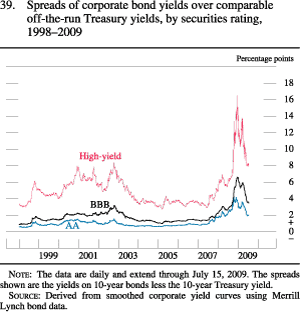
This chart suggests a long-term average yield premium for AA corporate bonds over US gilts is about 1%, and for BBB bonds it is about 2%. So for A2 bonds ou might expect a normal yield premium of 1.5%, and a best-case of about 1%.

According to wikipedia a decrease in yield of 1% will increase the value of a bond by its Macauley duration. So if the 2.3% yield premium on SLXX decreased to 1.3%, its price might increase by about 8-9%. If we assume it takes 2 years for that to be achieved, then the total return on SLXX will be about 10% per year (5.6% of interest/dividends, and 4-4.5% of capital growth).

Currency
If I was planning to live in the UK indefinitely, then I would probably hold onto SLXX. But I'm not - I'm expecting to move to Norway within the next year. 43% of my shares are linked to the pound to a large extent - they are either UK companies with most of their revenue in sterling, or UK bonds. In addition, I have a house, and some cash, and a mortgage.

The net of that is that about two-thirds of my net wealth is tied up in sterling. That's a long way from the ideal - I'm facing significant currency risk. SLXX is not helping - but selling it and holding the cash will not help either, so I need to have a plan in mind for what to switch into before I sell.

Conclusion
I'm content that SLXX is worth holding for its expected return, but it's not giving me the international diversification that I require. I will start looking for an alternative to switch into.