Wednesday, 21 April 2010

Game Group

It's been a while since I bought a new share, but I'm seriously considering dipping my toe in the water for the sake of Game Group. They announced their preliminary results today, with the following highlights:
  • Operating profit down 28%.
  • Revenue down 10%.
  • Their CEO and UK Chief Operating Officer are both stepping down.
  • For the first 11 weeks of the year like-for-like sales are down 14%.

How could I resist?

Background

Game Group are the market leading game store in the UK with 600-700 stores. They have another 700 abroad, but derive over 60% of their revenue from the UK. They also sell online, but their online revenue is only ~5% of the total.

Prospects

Game faces competition from other games shops (HMV is probably their biggest threat, given that it's desperately replacing its diminishing CD revenue), non-specialist retailers like Tesco and Argos, and online retailers such as Amazon and play.com.

The key question is whether they can continue to trade profitably despite this barrage of competition. They have some points in their favour:

  • 20% of their revenue comes from their pre-owned offering, and their gross margin on these sales is over 40%. In this segment they are relatively immune from online and supermarket competition, so it's basically them and HMV.
  • Their reputation as a specialist retailer means that they will be a popular choice when buying peripherals - these form 13% of their revenue, and have a gross margin over 30%.
  • People may be reluctant to make a very large purchase online, which means that Game and the other terrestrial retailers have an advantage when it comes to new hardware sales. New hardware forms 25% of Game's revenue, with a margin of ~22%.

I think it likely that online sales of new software will continue to increase, which will eat into Game's store-based revenue. But at least some of that growth will go to Game's online business, and they should be able to close stores as they become unprofitable. They may turn into quite a different sort of business over the long run, but I don't think their business model is going to implode anytime soon.

Income

If we're looking at a business in slow decline, it's important to make sure that they are not going to be strangled by fixed costs and tip into unprofitability in a few short years.

Their total gross margin is about 28%. About 80% of that goes into selling, distribution and administration (including about 30% in staff costs), to leave a net operating margin of 5.6%.

Assuming their fixed costs are entirely fixed, then a 10% fall in revenue should result in a 10% fall in gross profit, and that should then carry through into a fall of 50% in their operating profit. Nasty! 10% may even be optimistic, since like-for-like sales so far this year are down 14%.

Clearly there are substantial risks to the downside here.

Balance sheet

Game have a Net Tangible Asset Value of £150m. They have £176m of inventory, but this is more than funded by their £260m of trade and other payables. They have £86m of cash, offset by £40m of debt.

It's interesting to compare their £176m of inventory with their total revenue of £1.7bn. That suggests products sit on their shelves for an average of only 36 days before being sold. Crikey - that's far less than I would have guessed. Suggests they're running a pretty tight ship.

Price

Now we come to the interesting bit. Clearly this is a company facing some significant risks and uncertainty. It will need to be trading at a pretty decent price for it to be worth investing.

Today Game has a share price of 89p, and a market cap of £354m. In 2009 they earned £64m after tax, for a P/E ratio of 5.5. In 2008 they earned £103m after tax, which would mean a P/E ratio of 3.4 - that's unlikely to represent an ordinary year, but shows what is possible if the market picks up a little.

If the game market stages a recovery, then I think Game could achieve post-tax earnings of ~£80m. If that persisted for a couple of years, then uncertainty may recede, and Game Group might be accorded a P/E ratio of 12. That would mean a market cap of £960m and an increase in the current share price of 170%. Add in four years of steadily increasing dividends and the total return would be 200%.

On the downside, a continued decline in revenue could quickly lead to Game making losses. A couple of years of that would result in them running out of cash, and once that happens Game would be staring into the abyss - the shares could easily go to zero.

Conclusion

This is by no means a dead cert, but I think a 200% upside makes it a decent punt.

Update 22/4/10:

Bought this morning at 92.6p. Game now forms a little over 4% of my portfolio.

Thursday, 18 March 2010

Letting the tax tail wag the investing dog

Today I sold a share for tax reasons. I'd rather not be doing that, but unfortunately the treatment of capital gains tax in the UK and Norway is so different that I'd be mad not to take advantage of the UK rules while they still apply to me.

I'm planning to move to Norway late in 2010 - late enough that I'll still be resident in the UK for the 2010/11 tax year. We're still a couple of weeks short of the end of the 09/10 tax year, so I effectively have two tax years to play with, and two capital gains allowances (I invest on my wife's behalf as well as my own).

In the UK I can make a capital gain of £10100 before I pay capital gains tax. When I do pay tax, it is charged at 18%. In Norway, although there are some minor allowances, the tax rate is effectively 28% on the entire sum. Furthermore, although I have some of my investments in ISAs, these do not shelter me from Norwegian taxes.

Over the last 12 months I've made some significant capital gains - and I'd rather not give up 28% of my profit to the Norwegian state. So I've reluctantly decided to sell any of my investments with a significant capital gain attached. Using up the remainder of my 09/10 allowances means selling Barclays - which I did today for an overall profit since purchase of 289%.

Over the next 6 months or so I will be selling up other shares where I can save tax in doing so. I'll need to take account of dealing costs (selling and buying), stamp duty, and the bid/ask spread. Once I have the cash in hand, I may buy straight back into the same share (after waiting the minimum 30 days to avoid HMRC's bed and breakfasting rules) or I might put my money to work elsewhere.

I'm going to end up selling the vast majority of my portfolio, with the exception of LLPC, BDI, QDG, CPT, MXM.

As to whether I will reinvest in Barclays, I'm not sure I can make a convincing enough case. I think it is probably worth more like 450p than 350p, and a potential 30% increase is not to be sneezed at, but I think there are probably better alternatives. I'll be looking into some of those soon.

Saturday, 13 March 2010

SLXX - should I sell?

Today I'm going to look at whether SLXX still deserves a place in my portfolio, or whether I should sell. I've held them for almost a year, and in that time I've earned a capital gain of 20% and 7% of dividends. Pretty good, huh? Well, actually no. In that time the FTSE is up over 50% before dividends. On the other hand, if I'd kept the money in cash I would have earned less than 2%, and at least SLXX did better than that.

Yield
Right now SLXX has a yield to maturity of 5.6%. Its Macauley Duration is 8.7 years. How much of a risk premium is built into that yield? IGLT holds UK government gilts - it has a yield to maturity of 3.3% and a Macauley duration of 8.3 years. We can consider that the risk free rate, and the durations are close enough to afford a direct comparison. The risk premium in SLXX is therefore 2.3%.

Is 2.3% a reasonable figure? To work that out we need to know the default risk of the bonds making up the ETF. That is unknowable, but we do have the ratings. Here's how the holdings break down:
Aaa -- 5%
Aa1/2/3 -- 26%
A1/2/3 -- 42%
Baa1/2/3 -- 27%
Ba1 -- 2%

So they're grouped fairly evenly around a central rating of A2. That is defined as "Safe investment, unless unforeseen events should occur in the economy at large or in that particular field of business". Not super-helpful. Moody's historical default rates for bonds rated A2 is about 0.4%, according to this paper. The economy is in a pretty dire state, so we could legitimately assume the actual default rate could be higher than 0.4% for a few years. Call it 0.8% for safety.

That suggests that holders of SLXX are being rewarded with an extra 1.5% of yield, over and above the expected default rate. That seems a little on the high side, but it is never going to reduce to zero.

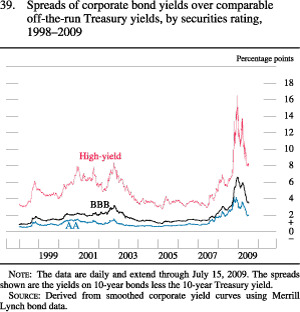
This chart suggests a long-term average yield premium for AA corporate bonds over US gilts is about 1%, and for BBB bonds it is about 2%. So for A2 bonds ou might expect a normal yield premium of 1.5%, and a best-case of about 1%.

According to wikipedia a decrease in yield of 1% will increase the value of a bond by its Macauley duration. So if the 2.3% yield premium on SLXX decreased to 1.3%, its price might increase by about 8-9%. If we assume it takes 2 years for that to be achieved, then the total return on SLXX will be about 10% per year (5.6% of interest/dividends, and 4-4.5% of capital growth).

Currency
If I was planning to live in the UK indefinitely, then I would probably hold onto SLXX. But I'm not - I'm expecting to move to Norway within the next year. 43% of my shares are linked to the pound to a large extent - they are either UK companies with most of their revenue in sterling, or UK bonds. In addition, I have a house, and some cash, and a mortgage.

The net of that is that about two-thirds of my net wealth is tied up in sterling. That's a long way from the ideal - I'm facing significant currency risk. SLXX is not helping - but selling it and holding the cash will not help either, so I need to have a plan in mind for what to switch into before I sell.

Conclusion
I'm content that SLXX is worth holding for its expected return, but it's not giving me the international diversification that I require. I will start looking for an alternative to switch into.

Thursday, 18 February 2010

Tinkering vs masterful inactivity

Over the last 2 years I've sold 10 shares out of my portfolio, and every time I've felt a sense of unease. I know that tinkering too much with your portfolio is a way to lose money - after all, every trade eats into my returns via dealing costs and stamp duty.

Thus far I've been reluctant to look too closely at what happened after I sold - after all I don't really want to know that I've missed out on oodles of potential profit. Today I've decided to bite the bullet and go digging, to see whether I really would have been better sitting on my hands.

Firstly, here are the shares I've sold, and what I replaced them with:
  • IEER, swapped into IEEM.
  • IFFF, swapped into IEEM.
  • LTAM, swapped into IEEM.
  • EDD, sold in order to buy more ZRX.
  • ZRX, sold because I was fed up; the proceeds went into NWBD.
  • TW, sold because I was fed up; the proceeds went into BATS and NG.
  • HSBA, sold in order to buy CPT.
  • RBS, sold mostly in order to buy LLPF, although some proceeds went into BATS and NG.
  • LLOY, sold in order to buy GSK.
  • LLPF, sold in order to buy LLPC.

Let's take a look at those and see how I did.

Emerging market ETFs

I swapped IEER, IFFF and LTAM into IEEM in order to simplify my portfolio. I expected the returns from IEEM to be almost identical.

Since then IEER, IFFF and LTAM are up an average of 94%, whereas IEEM is up 79%. Not disastrous, but clearly I would have been better off not interfering on this occasion.

EDD

This one stings. I sold EDD to buy more ZRX shares. Since then EDD is up 220%, and ZRX is down 90% (although I sold ZRX after it had fallen a mere 40%). Ouch. I should really take a look at what's been happening at EDD since I sold, and work out where I went wrong - but let's save this for another day.

ZRX

I sold my Zirax shares after a brief rally, and for once managed to get my timing spot on. After I sold they fell over 80% (and will be delisted next Monday). Shame I ever held the shares in the first place, but at least I picked a good time to sell. Furthermore, the proceeds went into NWBD, which is since up 22%.

TW

Taylor Wimpey is another share where I sold out after taking heavy losses. They're unchanged from when I sold (although along the way there were better selling opportunities at about 50p). I didn't really sell in order to buy anything in particular, but after a couple of weeks the cash went into BATS and NG, which have since returned about 20%, so I think I'll count this one a success.

Bank shares

HSBC has risen 33% since I sold them (not including dividends), whereas CPT has returned a total of 18% even including dividends. So chalk that one down as another error.

RBS is down 30% since I sold; the proceeds of this sale went into NG (up 15%), BATS (up 25%) and LLPF (up 152% when I sold).

LLOY is down 37%, although there once you adjust for the rights issue that's only about 20%. All the proceeds of that went into GSK, which is up 7% since then.

Finally there's the trade I made from LLPF into LLPC. There were 3 outcomes for LLPF: holding onto them, taking Lloyds' cash offer, or exchanging for LB1G ECNs. Holding onto them would have lost me 12%, but realistically I would never have done that. Exchanging for cash would have given me an extra 2%. The ECNs are now trading significantly above the level that LLPF was pre-exchange, and they would have netted me 15%. In the meantime I'm roughly where I started with LLPC, down only 1%.

Conclusion

OK, so 6 out of 10 sales lost me money once I take into account what I did with the proceeds. On the other hand, my average profit on a successful sale was more than triple my losses on a bad sale. And that disastrous EDD to ZRX swap was more than outweighed by the stonking profits when I traded in RBS for LLPF.

On the whole I've done pretty well. If I'd kept these 10 shares, they would now be up 8%. But the shares I've replaced them with have given me a return of 35%.

So tinkering turns out to have been a smart move after all - although I think I'll be resisting the temptation to do much more of it. Masterful inactivity is the order of the day.

Tuesday, 2 February 2010

International diversification

I've recently added a pie chart to my portfolio page showing the breakdown internationally and (within the UK) the split between shares and bonds. At the moment it looks like this:


The UK represents a scarily large proportion of that pie, given that I'm attempting to be well diversified. But appearances can be deceptive. I've rated shares like GlaxoSmithKline, British American Tobacco and Diageo as "UK shares" just because they are listed in London. But in fact the huge majority of their revenue comes from abroad. So even if the UK economy tanked, these companies would still do well.

I've attempted to come up with a more accurate picture by dividing up the UK shares according to the source of their revenue, and then allocating that to the other slices of the chart. The result looks much healthier:


Although this looks like I'm now rather overweight in UK bonds, that is no bad thing while I still have a mortgage denominated in sterling. It suggests a good home for my next investment is in Asia or Emerging Markets.

Monday, 1 February 2010

Inflation

Today I'm going to talk a bit about inflation. I was recently asked whether I thought investing in gold is a good hedge against inflation. In short, my answer is "yes, but I think there are better alternatives". I'll try to cover as many alternative approaches as I can here, and work out roughly what return an investor might expect, and what risks they might run. As with everything on this blog, this is all my own opinion, it's not intended as investment advice, and you should use it at your own risk.

In my examples I'm going to work out the expected return for a taxpayer paying tax at 20%, assuming two different rates of inflation: 3% (which is pretty much what I expect) and 8% (as a reasonably plausible worst-case scenario).

Physical cash
I'll start with an option which is almost certainly not smart: holding physical cash. Under the mattress for instance. You earn no interest, but there are no associated costs. Every £1 of your money will still be there in 10 years time, but inflation will have reduced its purchasing power. Assuming 3% inflation per year, your £1 will only be worth 74p in real terms. Your annual real return (i.e. after inflation) using this method is minus RPI.

Expected real return: (0 - RPI) e.g. -3% / -8%
Risk: moderate (theft, fire)
Flexibility: very high

UK-based Savings account
The best-buy savings accounts tend to pay an interest rate roughly equal to the Bank of England base rate. If you put your money in a UK-based savings account, and switch accounts regularly to take advantage of the best rate, you can probably earn a return roughly equal to the base rate.

But would that be more or less than the rate of inflation? In normal circumstances you would expect the BoE base rate to exceed the rate of inflation. Most people would rather consume goods today, rather than next year. The rate of interest is the reward for delaying consumption. If the rate of interest is lower than the rate of inflation, then in real terms the interest rate is negative - people are being penalized for delaying consumption. That might prevail for a period, but over the long run you would expect the real interest rate to be positive. In recent times the real interest rate has been approximately 2%.

Tax muddies the water here. If the rate of inflation is 8%, the base rate is 10% (and you earn this in a savings account), then your real return is +2%. But if you pay tax at 20%, then your real return is zero.

Expected real return: ((BaseRate * (1 - TaxRate)) - RPI) e.g. 1% / 0%.
Risk: Low. zero capital risk (assuming you spread your money around enough to benefit from the government savings guarantee) but you run the risk that the BaseRate may fall below RPI, or that banks may pay less than the BaseRate on their savings.
Flexibility: very high

UK gilts
Buying government gilts gives you an almost identical return to a UK savings account. If you stick to short-dated gilts there is minimal price risk, and it removes the risk that you might not find a savings account paying the BoE base risk. On the other hand, buying and selling is slightly harder than just withdrawing cash from your account.

Expected real return: ((BaseRate * (1 - TaxRate)) - RPI) e.g. 1% / 0%.
Risk: Zero.
Flexibility: High

NS&I savings bond
National Savings and Investments offer a 3-year and 5-year index linked savings bond, paying (RPI + 1)% - and it is tax free.

Expected real return: 1% in all circumstances e.g. 1% / 1%
Risk: Zero (guaranteed by government)
Flexibility: Low. Your cash is tied up for at least 3 years.

Gold
Gold is an interesting case. Over the very long term you would expect it to track inflation, but over the short run the price is extremely volatile. There are also costs associated with it - holding physical gold involves significant dealing costs, and even holding it through an Exchange Traded Fund will usually incur an annual charge of 0.4%. Capital gains are also subject to tax unless you hold physical gold that is legal tender in the UK (e.g. gold sovereigns).

Expected real return: (0 - fees - tax) e.g. -0.4% / -0.4% (assuming you keep below the threshold for paying capital gains tax and hold it through an ETF.
Risk: High. The gold price is extremely volatile.
Flexibility: High. If you hold through an ETF you can sell some of your shares at any time to realise cash.

Sterling corporate bonds
Corporate bonds will typically pay a rate of return higher than the BoE base rate. An investment grade corporate bond might pay around 1% more than base rate. The tax situation and overall return is similar to that of a savings account, but there is greater risk (companies can default on their debts, although if you hold high-quality bonds that is extremely rare - Lehman Brothers is the only recent example that springs to mind). There is also greater volatility if you hold longer-dated bonds, since these will fluctuate according to economic circumstances.

Expected real return: (((BaseRate + 1) * (1 - TaxRate)) - RPI) e.g. 1.8% / 0.8%.
Risk: Moderate. Your capital is at risk (albeit quite a low risk) and there can be short-term fluctuation in bond prices. There is also the risk that bond yields may fall below inflation.
Flexibility: High. You can sell your bonds at any time.

Foreign currency savings, gilts, bonds
I'm not going to cover all of these in any great detail. Anything denominated in a foreign currency brings the serious disadvantage of currency risk. Theoretically, over the long term, exchange rates should be determined by the relative rates of inflation in two countries. Therefore, If inflation in the UK is 8%, and the rate in the US is 3%, then in one year the pound should fall by 5% against the dollar. However, investing your money in the US should earn you a lower rate of interest, since you would expect the interest rate to be 5% lower in the US. So in theory these should cancel out, and you will be no better or worse off investing abroad. In practice, however, exchange rates fluctuate far more than this, and therefore you are exposing yourself to substantial currency risk for (in theory) no greater rate of return.

Expected real rate of return: identical to similar UK investment.
Risk: High. Exchange rates can be very volatile.
Flexibility: High.

Inflation-linked annuity
If you are at or close to retirement age, an annuity might be a sensible choice. Current inflation-linked annuity rates for a couple aged 65, with the payout to the surviving spouse reduced to two-thirds after the first spouse dies, are about 2.9%. You would then have to pay tax on that income, so that would equate to about 2.3%. You can try out other numbers here: http://www.fsa.gov.uk/tables/bespoke/Annuities.

Expected real rate of return: n/a since capital is used up, but pays a post-tax income of ~2.3%.
Risk: Low.
Flexibility: Zero.

Shares
Finally, lets get onto shares. To predict the return from shares you have to make a lot of assumptions, but here goes:

  • Let's assume that publicly listed companies form a roughly static percentage of the total economy.
  • Let's assume that profit margins at publicly listed companies are roughly static.
  • Let's assume that new capital investment in the stock market is negligible compared to the total market size (bit of a stretch).
  • Let's assume that the UK stock market is a reflection purely of the UK economy (this is simply wrong, because it is very diversified internationally).

At the moment you can earn a dividend yield of about 3.5% on the FTSE100. If the assumptions above hold true, then the earnings of the FTSE100 should increase at a rate of (inflation + GDP growth)%. The real rate of return to the shareholder is therefore GDP-growth + dividend-yield - tax. There is no dividend tax for a basic rate taxpayer, and provided you keep below the capital gains threshold, your return is therefore GDP-growth + dividend-yield.

Expected real rate of return: GDP-growth + dividend-yield, e.g. 6% / 6% (assuming 2.5% GDP growth)
Risk: High. Share prices are very volatile.
Flexibility: High. You can cash in shares at any time.

Summary
There are clearly a lot of choices here, and different options suit different people, but in my opinion there are some options that are inferior in every respect. I rate gold as one of these, and can see no circumstances in which it would be preferable to hold gold rather than an NS&I Savings Bond (unless you are speculating rather than investing).

The investments I rate as worthwhile are:

  • UK savings account, for maximum flexibility while still roughly keeping pace with inflation. If banks stop offering such generous rates you could switch into short-dated gilts.
  • NS&I Savings bond, for a guaranteed above-inflation return, with no risk and no tax, at the expense of flexibility.
  • Inflation-linked annuity, if you are of retirement age, cannot afford the risk associated with shares, and are willing to sacrifice capital for an inflation-linked income.
  • Shares, if you can afford to tie up your funds for the long term (at least 5 years) and have the temperament to ride out the volatility.

Wednesday, 27 January 2010

Shareworld and I part company

After 6 weeks or so of writing for shareworld we've agreed it isn't really working out, and therefore I'm returning to this blog as the main repository for my investment thoughts.

One thing I did do to shareworld which I think needs a permanent repository is an at-a-glance portfolio page. I've therefore created one here:
http://www.danieltebbutt.com/portfolio.html
I'll be updating this regularly - it's autogenerated from my portfolio tracking script, so I can re-publish it at the press of a button.